
ODRC Release Paths from Coshocton
ODRC becomes relevant when a Coshocton felony results in an Ohio prison commitment, when a court judicially releases a prisoner, or when the Adult Parole Authority supervises the person after prison. A transfer from the Coshocton County Justice Center into ODRC ends the county booking without ending confinement. Later ODRC status and release-detail fields describe the prison side of the case.
A state prisoner may move to APA Supervision, Released, Judicial Release, Transitional Control, or another recorded status. Transitional Control can involve halfway-house placement, an approved residence, or electronic monitoring under correctional authority. It is not the same as an unconditional discharge. Judicial release comes from the sentencing court and normally carries community-control conditions. These labels should be reported as written.
| ODRC label | Meaning for release research |
|---|---|
| Incarcerated | The person remains under prison authority despite any future date. |
| APA Supervision | Prison custody ended and ODRC supervision continues. |
| Judicial Release | The sentencing court moved an eligible person to community supervision. |
| Violator At Large | Release to supervision occurred, followed by an alleged absconding event. |
| Released | Read release detail and dates to determine which ODRC phase ended. |
| Transitional Control | Correctional control continues in a community-based placement. |
Search ODRC Coshocton Release Records
The ODRC Offender Search includes people incarcerated in state prisons, under ODRC supervision, or judicially released. It is not a statewide arrest search and should not be expected to contain every Justice Center booking. An offender number is the strongest search key. ODRC numbers use A, R, or W plus six digits without spaces or hyphens; some women's numbers require a leading zero.
- Search by offender number when it is available. Otherwise enter the last name, add the first name, and compare birth date.
- Set County of Commitment to Coshocton when tracing a state sentence from this county. A multi-county record may show only its first county.
- Run Status Released, then run APA Supervision. They answer different questions.
- Use the VAL query only for the specific question of a supervision violator at large.
- Open the individual detail and match county, docket, offense, sentence, and judge with the Common Pleas case.
- Read status, release detail, supervision dates, and the expected or eligibility date as separate fields.
The official search interface shows these status and county controls.
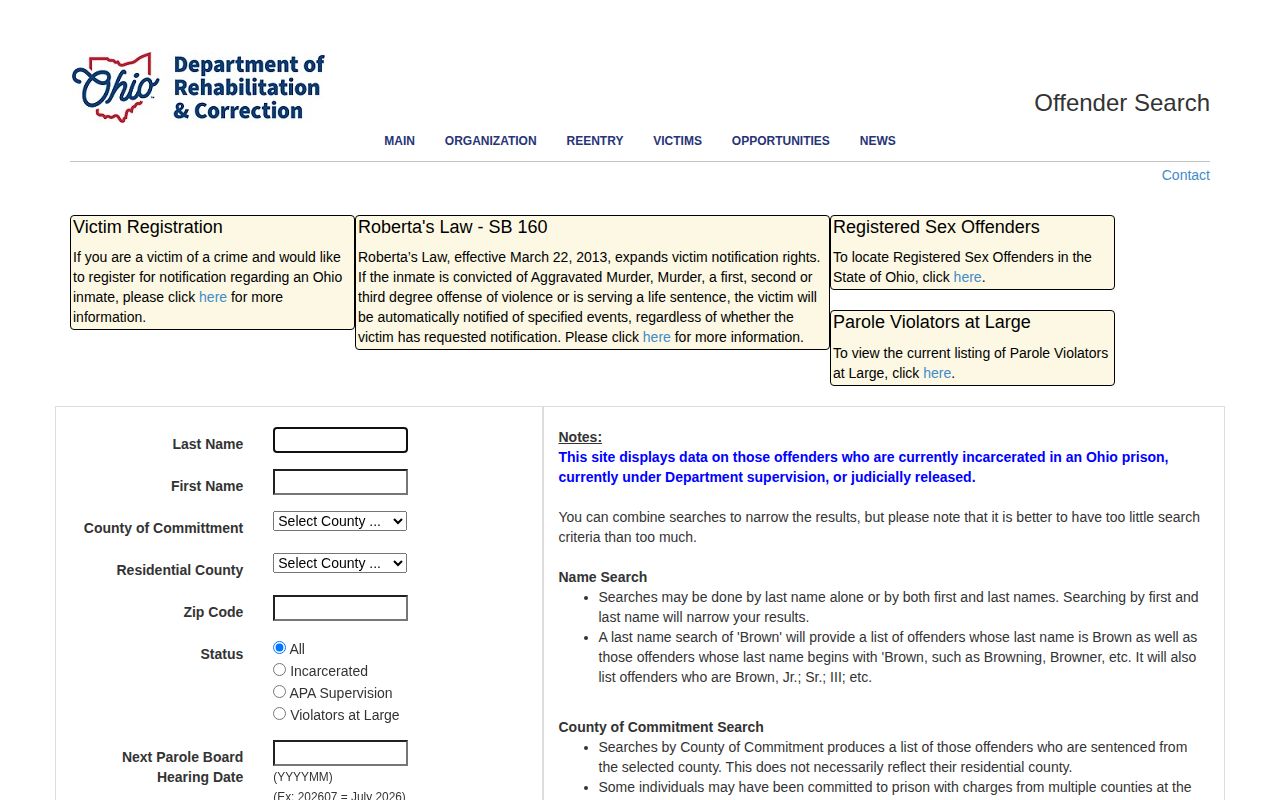
Residential County and ZIP apply to APA or VAL queries and reflect the last recorded residence. They are not live location tools.
ODRC Coshocton Release Fields
An individual detail can contain a photograph, status, admission date, institution, expected release or parole eligibility date, offense information, statute, sentence, effective date, jail-time credit, county, docket, judge, and concurrent or consecutive terms. After a release or parole event, the detail may add Parole or Release Detail. APA records may show supervision start, end, or early termination.
| Field | How to use it |
|---|---|
| Status | Separates prison custody, supervision, released status, and violation status. |
| County and docket | Connects the ODRC person to the correct Coshocton felony case. |
| Admission and institution | Shows the state custody episode and placement. |
| Expected Release Date / Parole Eligibility Date | A combined future milestone that needs sentence context. |
| Parole or Release Detail | May record the completed institutional action after it occurs. |
| Supervision dates | Shows when APA jurisdiction began and later ended or terminated early. |
| Offender photograph | Helps identity matching but is not a county booking photograph. |
Several dates can be correct for one person. Prison release can begin supervision, and supervision can end years later. A future expected date on an incarcerated record does not show that release happened.
Interpret ODRC Release Dates
The visible ODRC label combines Expected Release Date with Parole Eligibility Date. The official definitions distinguish PRD, parole on or after, TC or TT sentence expiration, and other milestones. Sentence type controls the meaning. A parole eligibility date opens a chance for consideration. It is not a grant. A projected date can also change through sentence calculations, credits, court action, holds, or discipline.
Court-awarded jail-time credit is separate from earned credit. The sentencing court determines qualifying confinement and states the number in its judgment; ODRC applies it. Consecutive and concurrent terms, mandatory portions, sentence era, and indefinite minimum or maximum structure also matter. A reliable review starts with the Common Pleas judgment and uses its docket number to reconcile the ODRC detail.
Never convert the combined ODRC expected or eligibility field into a guaranteed exit date.
For the full date analysis, including county schedule limits and state calculation rules, use the Coshocton County Release Date Lookup.
ODRC Earned Release Credit
Ohio Revised Code 2967.194 permits eligible people to provisionally earn specified credit for qualifying program work under the current framework. One ordinary category is capped at fifteen percent of the stated term. That limit is the source of a common “eighty-five percent” shorthand, but it does not mean everyone serves that share.
Some sentences and offenses are excluded, some people earn no such credit, and other completion credits operate differently. Credits remain provisional and can be denied or withdrawn. Older law may govern an older sentence. Jail-time credit is independent, while judicial release, Transitional Control, indefinite-sentence rules, parole decisions, and sentence structure can change the analysis. ODRC's current detail and the judgment entry outrank a rough calculation.
Note: A changed projected date may reflect a lawful recalculation rather than a data error.
ODRC Supervision After Coshocton Release
The Adult Parole Authority handles parole and post-release control. Search APA Supervision and open the detail for the supervision start, current status, and any published end or early-termination field. A person can be outside prison and still subject to ODRC authority. Completed supervision belongs in a Released search rather than the current APA set.
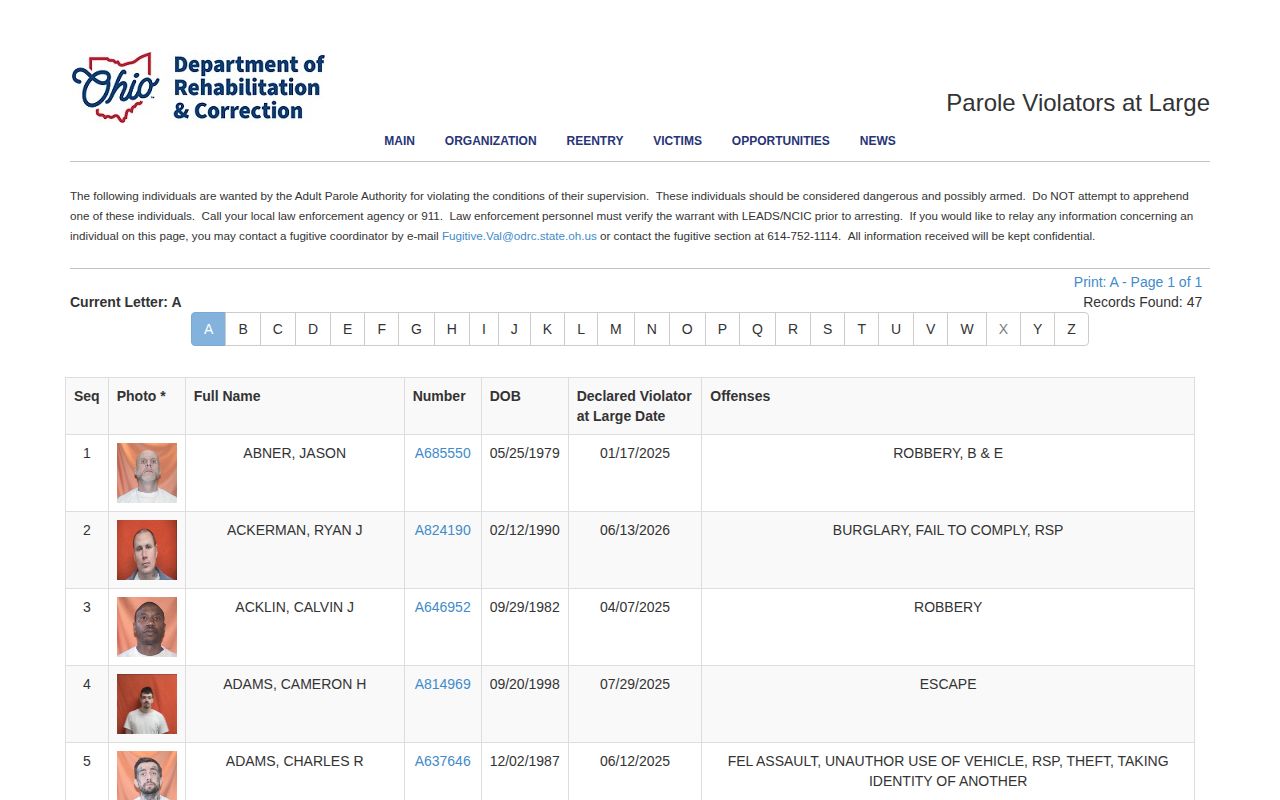
The statewide Parole Violators at Large list is a distinct channel. A listing means a person had been released to supervision and a later violation or absconding event followed. It does not erase the earlier release. The page warns the public not to approach a listed person. A Residential County filter can narrow results but must not be described as a present address.
The official violators-at-large interface states its own warning.
ODRC Release Records and Photos
For state records beyond the public detail, identify the offender number and request existing releasable documents showing the release date and type, supervision dates or status, places of incarceration, and offender photograph. OAC 5120-9-49 supplies the inspection and copy procedure. Ohio Revised Code 5120.21 permits disclosure of specified items despite broader restrictions within the correctional file.
An ODRC photograph may help confirm identity when the county PDFs show no image. It is an offender photo created in the state system, not necessarily the Coshocton booking image. Its date can differ from the arrest. The photograph cannot prove present release status by itself. Match it to the offender number, docket, and status fields.
Statewide Offender Search
Public-record procedure
ODRC and County Release Boundaries
The current Justice Center roster answers whether the current county snapshot lists a booking. ODRC answers whether an Ohio prison or APA record exists. A person can move from the county jail to prison and appear “gone” locally while remaining confined. Conversely, a short county sentence may never produce an ODRC record. The Common Pleas sentencing entry supplies the bridge when a felony commitment occurred.
Federal and immigration episodes fall outside ODRC. A U.S. Marshals detainee may leave a local jail through transport, and a federal sentence later appears in BOP. An immigration detainer can lead to ICE. Those cases require the federal or ICE path. Keeping each agency's custody boundary intact prevents a released label in one system from being mistaken for freedom from all authority.
Historical checks need both systems as well. The current county PDFs are overwritten and do not function as an archive. The durable felony docket can establish the judgment, while ODRC can preserve state admission, sentence, release detail, and supervision phases. Compare the dates instead of assuming the county booking end and state admission happened at the same moment.