
Coshocton Parole and Probation
A person outside the Coshocton County Justice Center may remain under a set of release terms. The agency depends on the case. The Ohio Department of Rehabilitation and Correction, or ODRC, uses its Adult Parole Authority to supervise parole and post-release control after an Ohio prison term. Coshocton Municipal Court oversees probation in its misdemeanor and traffic work. Common Pleas Court uses the term community control for felony supervision, including conditions imposed with judicial release.
Parole is release from a parole-eligible prison sentence under state authority. Probation is a court-ordered alternative or follow-on to local confinement in a court case. Post-release control is a statutory period after prison for covered sentences. The labels matter because an ODRC name search will not serve as a full list of Coshocton court probation cases.
| Supervision type | Who controls it | Best verification record |
|---|---|---|
| Parole | Ohio Adult Parole Authority | ODRC status, hearing, and release detail |
| Post-release control | Ohio Adult Parole Authority | ODRC APA Supervision detail and sentencing entry |
| Municipal probation | Coshocton Municipal Court | Municipal docket and court verification |
| Community control | Coshocton Common Pleas Court | Felony sentencing, judicial-release, and termination entries |
- Discharge
- The documented end of the supervision term.
- Absconder
- A supervised person alleged to have stopped reporting or left supervision without authority.
- Judicial release
- A court-ordered prison release to community-control conditions.
- Transitional Control
- An ODRC-controlled placement that may use a halfway house, approved home, or electronic monitoring.
Check Coshocton Post-Release Supervision
Verification begins with identity and the custody path. An ODRC offender number is stronger than a name alone. If no number is known, compare date of birth, Coshocton County of Commitment, docket, and sentence data. ODRC last-name searches use prefixes, so a short name can yield people who are not the right match. For a court case, use the case number and charge history to avoid mixing two people with the same name.
- Search the ODRC Offender Search with Status set to APA Supervision. Use an offender number when available.
- Run a second ODRC search with Status set to Released. Current supervision and completed supervision are different result sets.
- Use County of Commitment as Coshocton to narrow a state case. Treat Residential County only as the last recorded county, not a live address.
- Open the person detail. Compare birth date, docket, sentence, Supervision Start Date, Supervision End Date or Early Termination, and Parole or Release Detail.
- For a local misdemeanor, check the Municipal Court record search. For a felony, use Common Pleas eAccess and read sentencing, community-control, revocation, and termination entries.
- Ask the proper court to verify any term not clear online. A docket can lag a signed order or omit protected content.
The broader Coshocton County released-inmate search and record path can help when the first issue is whether the person left the county jail at all. A county roster disappearance alone cannot identify parole, probation, or a transfer.
Note: ODRC may record only the first commitment county in a multi-county case, so compare the docket and offender number.
Coshocton Supervision Record Offices
No separate public Coshocton APA field-office listing was verified in the research. The reliable state route is the ODRC record and its Adult Parole Authority data. Local probation belongs to the court that entered the order. Contact the court only after matching the case, and ask for an existing docket entry or supervision record rather than a broad conclusion about the person.
Local court verification
Coshocton Common Pleas Court
318 Main St., second floor
Coshocton, OH 43812
Clerk Legal Office: 740-622-1456
Monday-Friday, 8:00-4:00
Coshocton Municipal Court
740-622-2871
Monday-Thursday, 8:00-4:00
Friday, 8:00-noon
ccmunicourt@coshoctoncounty.net
Common Pleas computerized records generally begin with cases filed January 1, 1999, unless an older case later reopened. Online document images began November 1, 2019, subject to legal limits. Domestic-violence matters are excluded from the public online record. Municipal entries may lag court action by at least 24 hours and sometimes longer. None of those limits proves that no supervision record exists.
APA Holds on Coshocton Releases
The Coshocton County Scheduled Releases report can display APA / DRC in its additional-bond column. That county-specific label shows why a local tentative date may not become a community release. State authority can still block discharge or require a transfer. The schedule is uploaded once each day, and paperwork received after the upload may wait until the next report.
Three systems must remain separate. The Sheriff schedule forecasts a county event. ODRC shows state prison and APA status. The Municipal or Common Pleas docket shows the court order. Residential County in ODRC works only with APA Supervision or Violator At Large searches and can lag. It must not be published as a current address.
The ODRC definitions page explains these status fields. Its official view also shows how prison release, APA supervision, and completed supervision can have different dates. That distinction prevents a tentative jail date from being recast as a final state release.
The official ODRC definitions interface illustrates the status and date terms used in these checks.
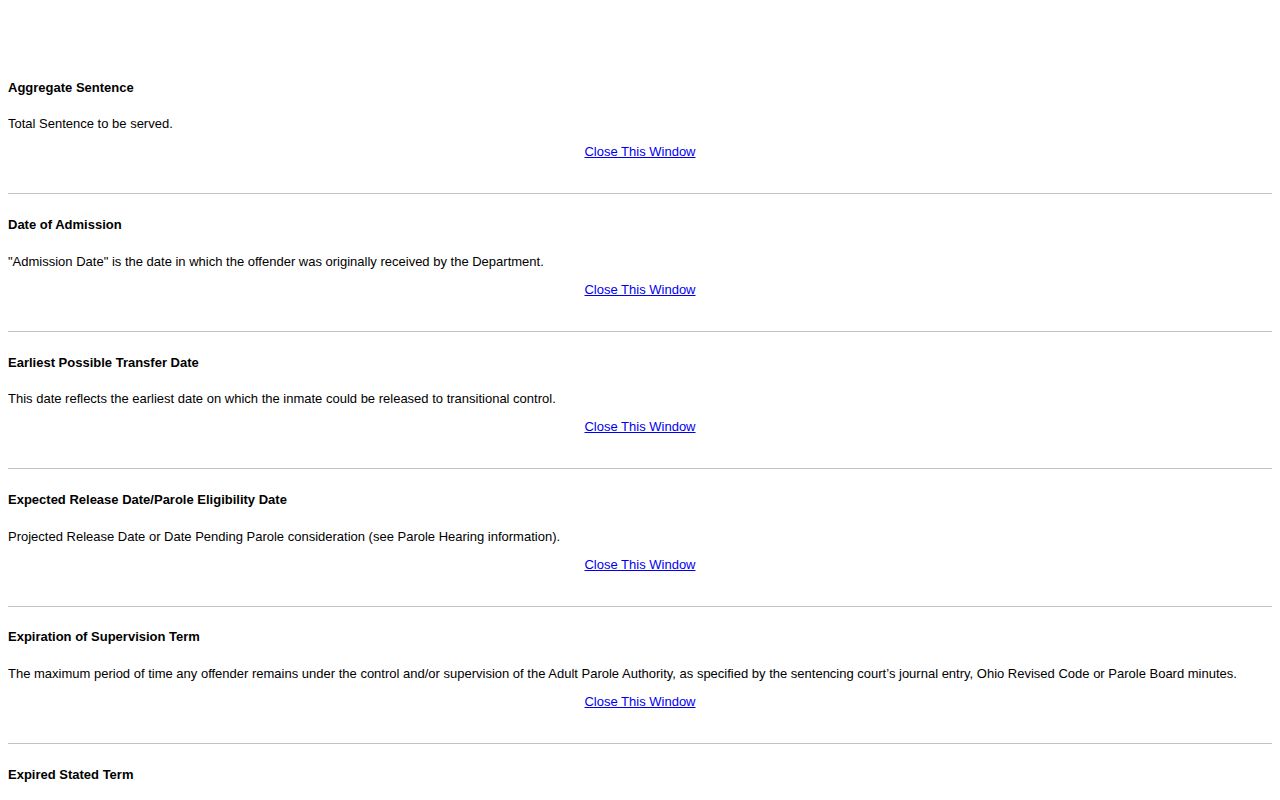
Read the displayed label first, then test it against the sentencing docket and the person’s release detail.
Coshocton Supervision Violations
A violation does not erase the earlier lawful release. A person listed as Violator At Large was released to APA supervision and later became the subject of an absconder status. ODRC maintains a statewide Parole Violators at Large listing. Follow its safety warning and do not approach a listed person. There is no verified separate Coshocton County absconder list.
Court supervision uses a different record path. Municipal probation events appear with the local case. Felony community-control violations, revocation proceedings, and new sanctions appear in Common Pleas. An arrest or jail hold may be tied to one of those cases, an APA action, or another warrant. Confirm the controlling authority before describing the status.
The statewide Parole Violators at Large page makes clear that its purpose is a focused violator search, not a list of all people on supervision.
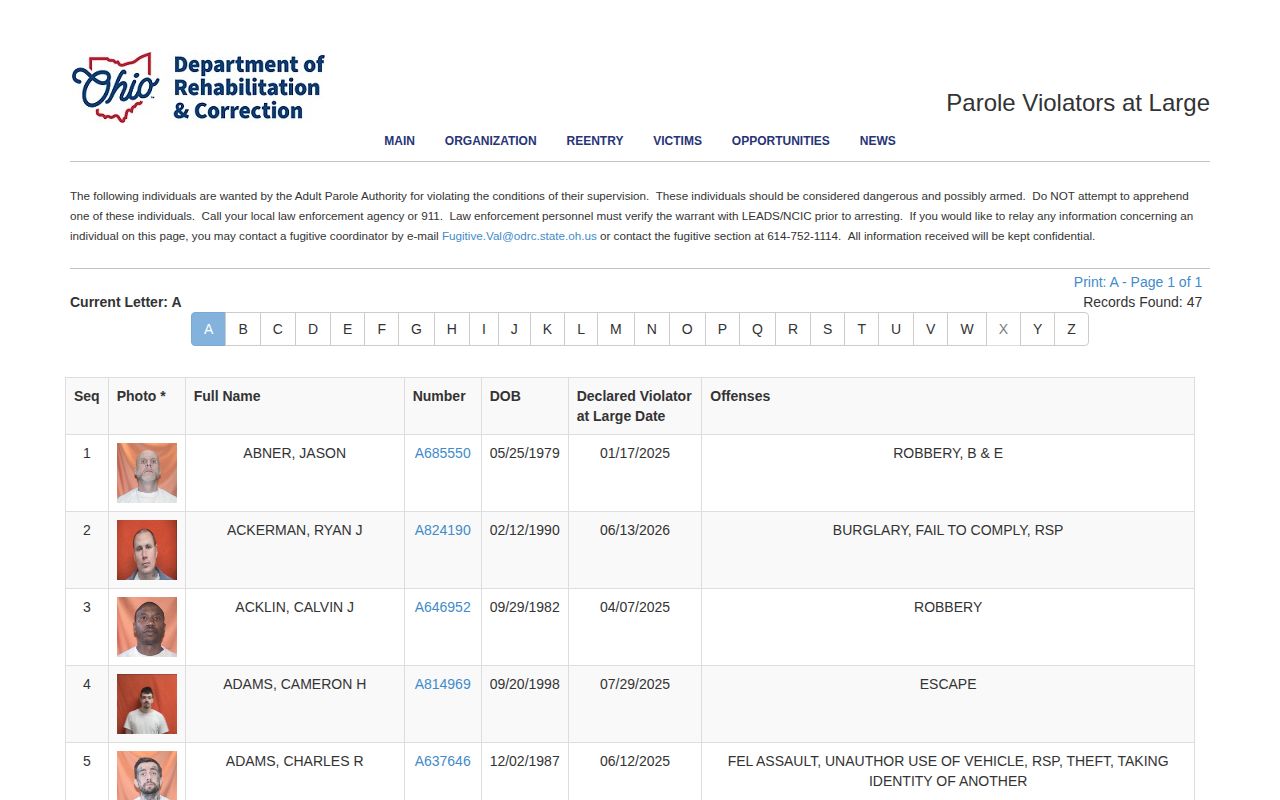
A no-result is not proof that no warrant, court violation, or local probation issue exists.
Note: A violation status concerns supervision after release; it does not identify the original county-jail release time or method.
Coshocton Parole Hearing Records
ODRC offers a Next Parole Board Hearing Date search by month. The query uses the format YYYYMM. Record both the searched month and access date because schedules can change. A matching hearing result means the person is scheduled for consideration. It does not mean parole was granted.
Ohio Revised Code 2967.13 sets parole-eligibility rules for covered sentences. Life without parole and certain other sentence types are excluded, while minimum periods and consecutive terms can shape eligibility. Non-life indefinite sentences operate under a different framework. The individual ODRC detail is the verified public route for hearing information and Parole or Release Detail.
Use outcome words such as granted, denied, continued, deferred, or rescinded only when an official individual record supports that exact result. No separate current general decisions portal was verified. Many probation and parole proceeding records also fall outside ordinary public access under Ohio public-record limits.
Property After Coshocton Release
Coshocton County publishes one narrow post-release account rule. Money in a separately established ICSolutions telephone account cannot be refunded by the Justice Center. The person must seek the refund from ICSolutions. The Sheriff’s public material does not state a final property-return process, identification-document handoff, or record-correction procedure.
For a county custody episode, the local fallback is the Justice Center or Sheriff Records Bureau. This practical issue is separate from parole or probation. A property question does not establish who supervises the person, and an APA record does not show whether jail property was returned.
Note: Confirm current pickup and property procedures directly because the county’s public pages do not document a complete release handoff process.
Coshocton Supervision Discharge Records
The end of supervision requires its own record. In ODRC, compare Status, Supervision End Date or Early Termination, and Parole or Release Detail. A person may first have an institutional release date, then an APA supervision start date, and later a supervision end date. All can be accurate because they mark successive legal phases.
For Municipal probation or Common Pleas community control, read termination or discharge entries in the case docket and verify unclear terms with the clerk. A judicial release order starts community-control conditions. Transitional Control remains an ODRC placement and should not be confused with a sentencing court’s judicial release. When no public detail shows a final result, do not infer completion from the passage of an expected date.
Ohio public-record law also has limits. The public ODRC detail and a court’s published docket are safer sources than an assumption that a complete parole or probation file is open. Medical, victim, security-sensitive, sealed, juvenile, and many supervision-proceeding records may be restricted. If an office withholds part of an otherwise public record, request the nonexempt portion and the legal basis for the withholding. A missing online item can reflect a coverage rule, a lag, or restricted access. It does not establish that the term never existed.