
Federal Release Paths from Coshocton
No federal prison was confirmed inside Coshocton County. The federal entry in the Facility Map is a custody and records path, not a claim that BOP operates a local institution. The Coshocton County Justice Center can serve some federal needs, and U.S. Marshals may house federal detainees in local jails. A person who disappears from the county roster may have been transported under federal authority rather than released into the community.
USMS controls federal detainees from court-ordered custody through acquittal or conviction and delivery to BOP when a prison sentence follows. A pretrial defendant may never enter BOP's sentenced-prison population. The federal docket is therefore the durable source for detention, release, dismissal, acquittal, sentence, and transport orders. Once BOP designates and receives a sentenced person, its locator becomes the main public custody channel.
| Federal phase | Best first source | What to verify |
|---|---|---|
| Local jail on federal writ | Federal docket and USMS role | Transport versus release order |
| Federal pretrial detention | Court detention or release order | Conditions and later case action |
| Sentenced BOP custody | BOP inmate locator | Register number, location, and date |
| End of BOP custody | BOP result plus federal docket | Release label, supervision, and detainer |
| Transfer to another authority | Detainer and receiving-agency record | Who assumed custody |
Search Federal Release Records
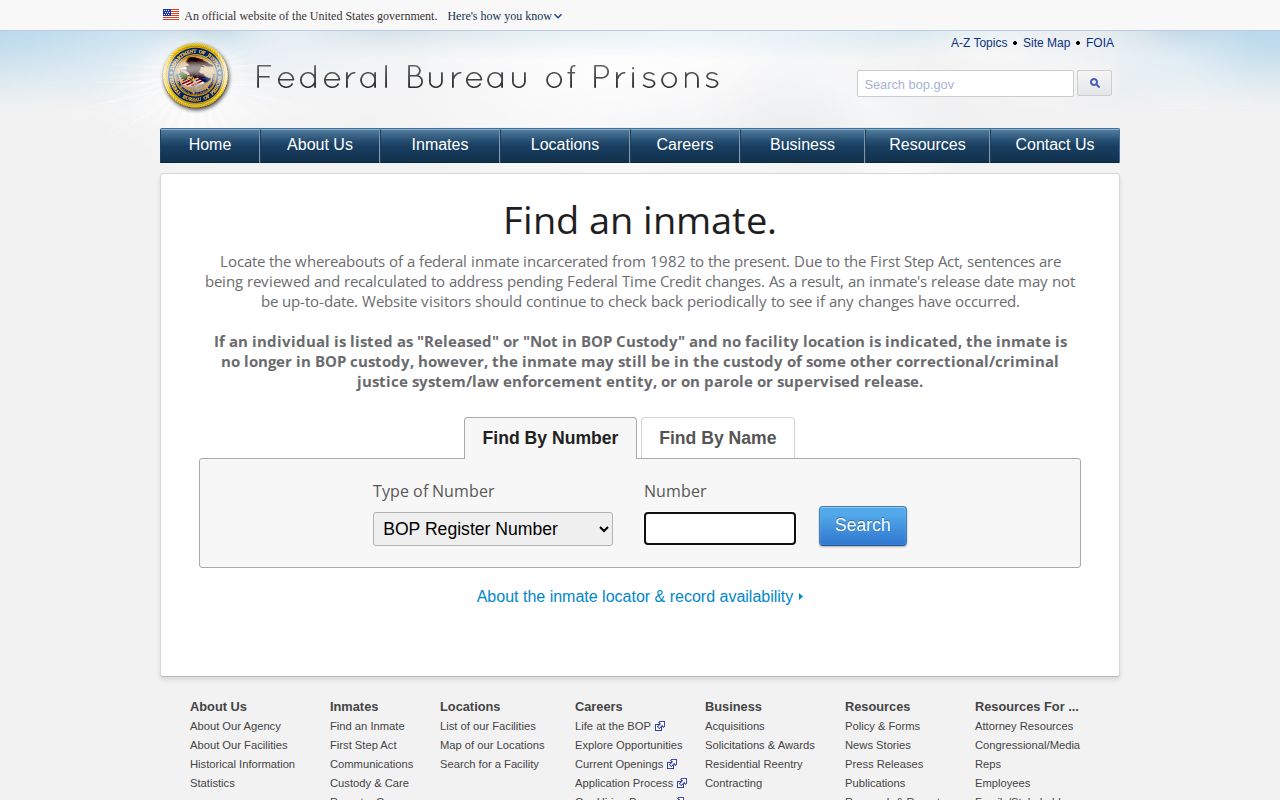
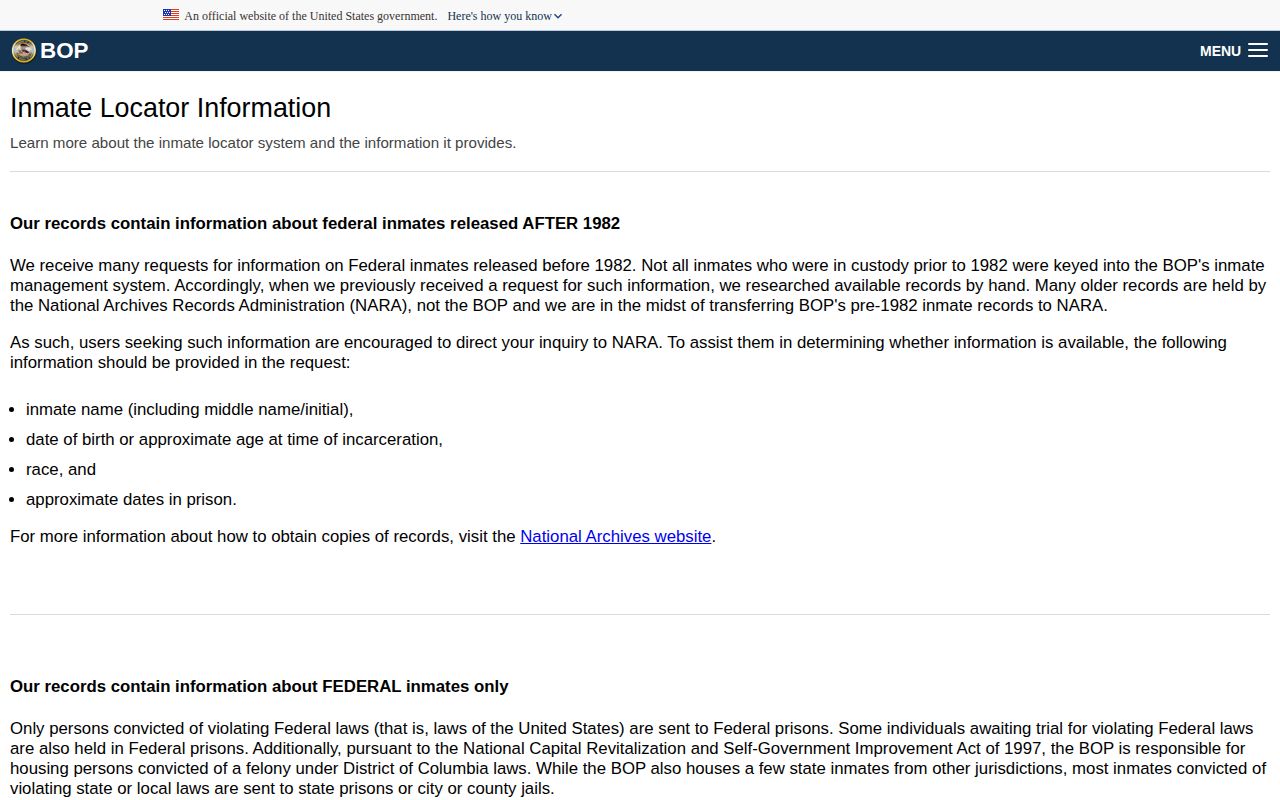
The BOP inmate locator generally covers federal prison records from 1982 forward. Search by a known register number when possible. Number searches are more precise than names. A name result should be checked against age, race, sex, and register number before any conclusion is drawn. BOP directs older inquiries to the National Archives.
- Choose the identifying-number search when a BOP, DCDC, FBI, or INS number is known.
- Otherwise search the exact name and compare all displayed identity fields.
- Read the release date together with the location or custody label.
- If the person is shown as released, read the federal docket for supervised release and later orders.
- If another custodian or detainer appears, use that agency's record before describing community release.
- Preserve the result date and exact wording because projected information can change.
The official locator demonstrates the number and name search routes.
A current Justice Center roster is not a substitute for this search after federal transport. Likewise, BOP is not the right first source for a pretrial defendant who was never designated to a federal prison.
Interpret Federal Release Labels
BOP results can display a release date and a location or status phrase. A past date paired with “RELEASED” or “Not in BOP Custody” supports the conclusion that BOP custody ended. It does not prove the person is free of all custody or supervision. A federal term of supervised release can begin after prison, and a detainer can deliver the person to a state, local, or immigration authority.
- RELEASED
- BOP custody ended as reflected in the locator; check what followed.
- Not in BOP Custody
- The person is not presently held by BOP, without deciding other custody.
- IN TRANSIT
- The person is moving within federal authority, not released.
- UNKNOWN
- The term or location may be undetermined, including some pretrial or unsentenced situations.
- Community Corrections Management
- BOP administration can involve a halfway house or other community confinement.
The BOP's About Inmate Records explanation describes these limits.
Federal Release Record Fields
The public locator supplies name, register number, age, race, sex, release date, and location. Those fields answer identity and basic custody questions, but they do not reproduce the institution's full release paperwork. A future date is projected and can change. First Step Act calculations or other sentence events may alter it, so an older saved result should not be treated as current.
BOP's Notice of Release and Arrival form provides a field-level model of institutional release. It distinguishes identity and numbers, institution, release date and method, release to the community versus a detainer, detaining authority, transportation, supervision jurisdiction, residence, and reporting instructions. A blank form does not prove an individual event. It explains why the release method and detainer fields matter when requesting or reading the actual record.
| Field | Question answered |
|---|---|
| Register number | Which federal person and record |
| Release date | Past event or current projection, read in context |
| Location | Facility, transit, community-corrections, or released label |
| Release method | How BOP recorded the institutional departure |
| Detaining authority | Whether another agency received the person |
| Supervision jurisdiction | Where post-prison federal supervision is administered |
U.S. Marshals Release Records
The U.S. Marshals Service manages federal prisoners but does not provide a public historical released-inmate locator comparable to BOP's. If a federal detainee leaves the Coshocton jail roster before designation to BOP, read the federal docket first. A release order, acquittal, dismissal, detention order, or transport entry can explain the change. The docket is also the source for the sentence and any term of supervised release.
A narrowly framed USMS Freedom of Information Act request may seek existing custody or tracking records. Privacy, security, and law-enforcement exemptions can limit the response. Ask for a defined person, time, case, and record rather than a general explanation. USMS also restricts ordinary prisoner photograph and departure details, so no federal mugshot or full movement history should be promised.
Federal Detainers After Release
A federal prison release can lead directly to another custodian. BOP's own release paperwork distinguishes a community destination from a detainer and names the detaining authority. BOP release statistics also exclude transfers to state sentences, ICE, and other custodial jurisdictions. That accounting rule reinforces the need to avoid treating every departure as community release.
A supervised person is generally directed to report as instructed after discharge. BOP's form contemplates reporting after the receiving authority later releases the person when BOP first released to a detainer. The federal docket can show supervised-release terms, but the exact physical destination may require the release record and the receiving agency's locator.
“Released” by BOP means the BOP custody episode ended. It does not cancel another agency's warrant, detainer, sentence, or supervision.
Federal and County Release Differences
The Coshocton Sheriff's schedule is a once-daily forecast for the county jail. It cannot predict a later BOP release. A county booking record may show transfer to USMS or another federal authority, but federal status must then be verified in the proper federal source. Conversely, the BOP locator does not prove an ordinary county-jail discharge that never became a federal prison case.
For a person who began in the Justice Center, preserve the booking number and the federal case number. Connect the Sheriff's recorded destination to the docket order. The official inmate information page supplies the county roster and schedule entry points. If the case produced a prison sentence, match the name and BOP register number. This chain prevents a roster disappearance, a transport entry, and a BOP release years later from being collapsed into one event.
The Coshocton County release-record search provides the county-first route when the original authority is uncertain.
Federal Release Limits and Corrections
BOP's public locator generally starts in 1982. Results can be updated after recalculation, and a projected date is not a promise. Names can collide, while aliases and data differences can hide a match. Record the register number whenever possible. A location marked IN TRANSIT should never be described as release, and Community Corrections Management should not be reduced to unconditional freedom.
When the public result conflicts with the federal docket, compare access dates and the precise event each source covers. The sentencing order establishes the court's judgment. BOP administers the sentence and reports custody. The release record explains institutional departure. The docket records later supervision proceedings. Corrections should be requested from the agency that owns the disputed field.
For pre-1982 custody, follow BOP's National Archives direction rather than reading a blank modern result as proof of no record. For a current discrepancy, retain the exact result label, access date, register number, and case number. Those details let the responsible office locate the field at issue and separate an old projection from a later completed event.
Note: Federal supervision can remain active even after both the county roster and BOP prison location are empty.