
Coshocton Projected Release Dates
Coshocton County uses two date systems with different meanings. The Sheriff’s Scheduled Releases PDF contains a county field spelled Tenative Release Date. It is a once-daily jail forecast. ODRC displays Expected Release Date/Parole Eligibility Date for state records. That combined label can represent a projected prison exit, a parole-eligibility milestone, or another calculation based on the sentence.
An actual release date records a completed event. A projected date estimates or schedules one. Court paperwork, a new hold, sentence credit, discipline, parole action, or a transfer can separate the two. A person can also leave the Coshocton County Justice Center for ODRC, another county, federal custody, or ICE. That ends the county booking episode without proving a return to the community.
Pretrial detention is different. A person awaiting case action often has no computable sentence end. Bond may permit release if paid, but another case or hold may block it. The controlling docket and Sheriff record must be checked together.
Find a Coshocton Release Date
Begin with the agency that has custody. Searching ODRC for a short county-jail stay can produce no result even when the local record exists. Likewise, today’s jail schedule will not calculate the end of an Ohio prison sentence. Keep the person’s booking, offender, and court case identifiers with every search.
- For the county jail, open the Sheriff’s Scheduled Releases report. Record its print date, the exact tentative date and time, and every entry under additional bonds.
- Read the Sheriff inmate-information warning. The report updates once daily, and later court paperwork may wait for the next upload.
- After the forecast time, compare the current roster. Absence is only a clue. Check VINE, the controlling Municipal or Common Pleas docket, and the Sheriff release record.
- For an Ohio prison term, search the ODRC Offender Search by offender number or name. Compare date of birth, County of Commitment, docket, and sentence data.
- Open the individual detail. Read Status separately from Expected Release Date/Parole Eligibility Date, hearing information, Supervision Start Date, and Parole or Release Detail.
- Read the sentencing judgment for the imposed term and court-awarded jail-time credit. Reconcile those values with ODRC rather than calculating from a news report or arrest date.
A historical county release is not reconstructed from today’s PDFs. Request the existing booking/release record from the Sheriff Records Bureau and ask for the recorded actual date, time, type, authority, and destination if maintained. The wider Coshocton County release-record search explains that record path.
Note: Keep the report print date because the county uses a stable PDF address whose contents can be replaced by a newer report.
Coshocton Jail Date Fields
The county schedule has only three core columns: the person’s name, the misspelled Tenative Release Date, and Bonds for Additional Charges. The last column can contain Sentenced, No Bond, Cash/Surety, Cash Only, 10%, an amount, a judge, Out of County Judge, or APA / DRC. Those entries are not all release reasons. They signal conditions or authorities that need the next check.
| Displayed item | What it can establish | What it cannot establish |
|---|---|---|
| Report print date | Age of the current forecast | Exact processing time after print |
| Tenative Release Date | Forecast date and time in that upload | Completed discharge |
| Bond type or amount | A listed condition on another charge | That the condition was met |
| APA / DRC | State authority is relevant | Community release or final APA action |
| Out of County Judge | Another court may control a hold | The destination after county release |
Formatting can compress principal and fees. Do not calculate what a person must pay from the PDF alone. The individual docket controls the bond order. If a date and another bond both appear, the Sheriff states that both conditions must clear.
ODRC Coshocton Release Date Lookup
ODRC searches cover people incarcerated in Ohio prisons, under APA supervision, or judicially released. The tool is not a statewide jail-booking database. Search fields include first and last name, offender number, County of Commitment, Residential County, ZIP, Status, and Next Parole Board Hearing Date. Last names are prefix searches. Offender numbers use A, R, or W followed by six digits without spaces or hyphens.
The individual detail can show status, admission, institution, sentence terms, offense, county, docket, judge, jail-time credit, concurrent or consecutive structure, and the combined expected-release/parole-eligibility field. The ODRC definitions distinguish PRD, parole on or after, and TC/TT sentence expiration. A future date on an incarcerated record remains a future milestone.
The official ODRC search interface shows the filters used to separate incarcerated, released, APA, and hearing records.
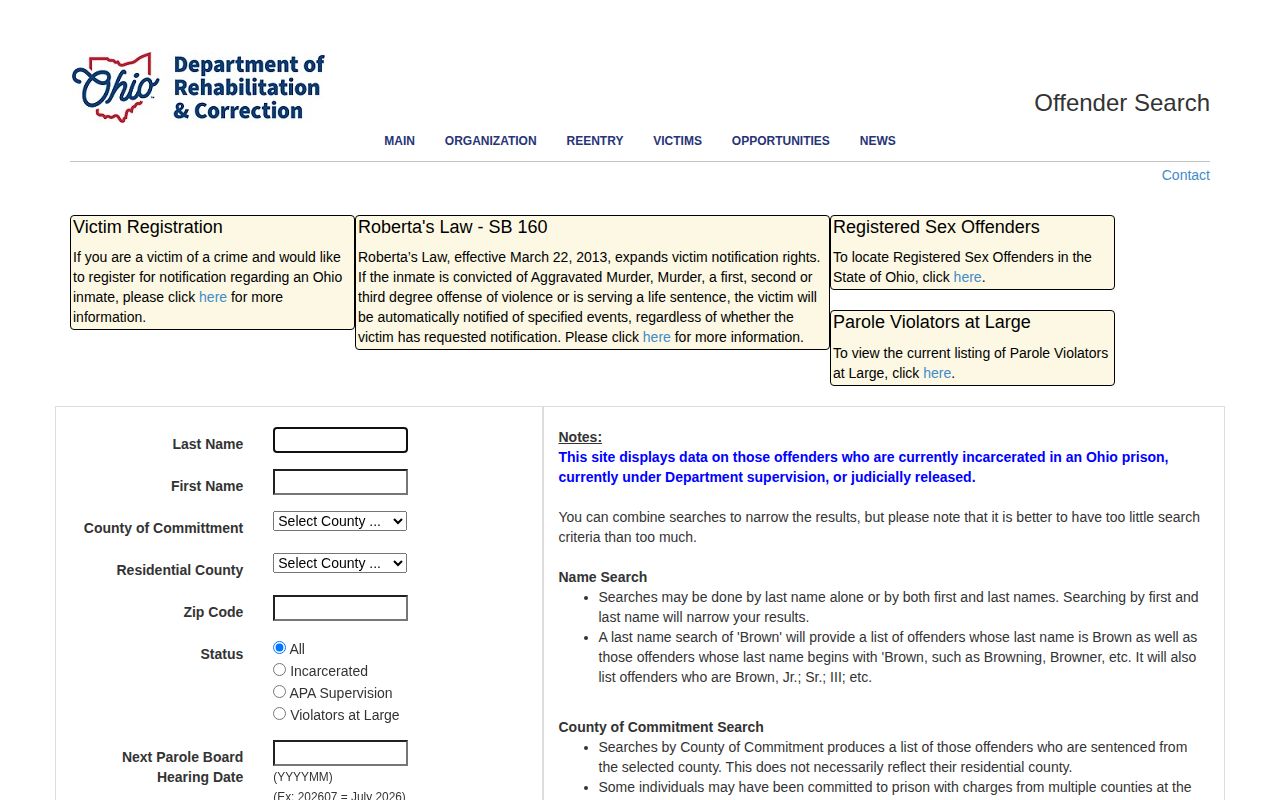
County of Commitment can connect an Ohio prison record to Coshocton, but a multi-county record may show only the first commitment county. Residential County applies only in certain APA or violator searches and is not a live location.
Ohio Credit and Coshocton Dates
Ohio sentence credit is not one flat deduction. Current ORC 2967.194 permits eligible people to provisionally earn one or five days for a completed month of qualifying program participation, depending on the category. Some qualifying completions can add credit. A defined diploma or program category can yield 90 days or 10% of the stated term, whichever is less, for a qualifying completion.
The ordinary participation and completion credit identified in the statute is capped at 15% of the stated term. That cap explains the shorthand that someone may serve 85%, but the shorthand is not a universal rule. Some people receive no such credit. Mandatory terms and specified sentence or offense classes are excluded. Credits remain provisional until final and can be denied or withdrawn. Earlier cases may fall under a prior version of the earned-credit law.
Court-awarded jail-time credit is separate. Under OAC 5120-2-04, the sentencing court determines qualifying confinement and places the number in the judgment entry. ODRC applies it. Calculation order can also depend on pre-SB2, SB2, HB86, or SB201 sentence eras, as well as consecutive and concurrent terms.
The official Ohio earned-credit statute gives a useful source view of the cap and exclusions.
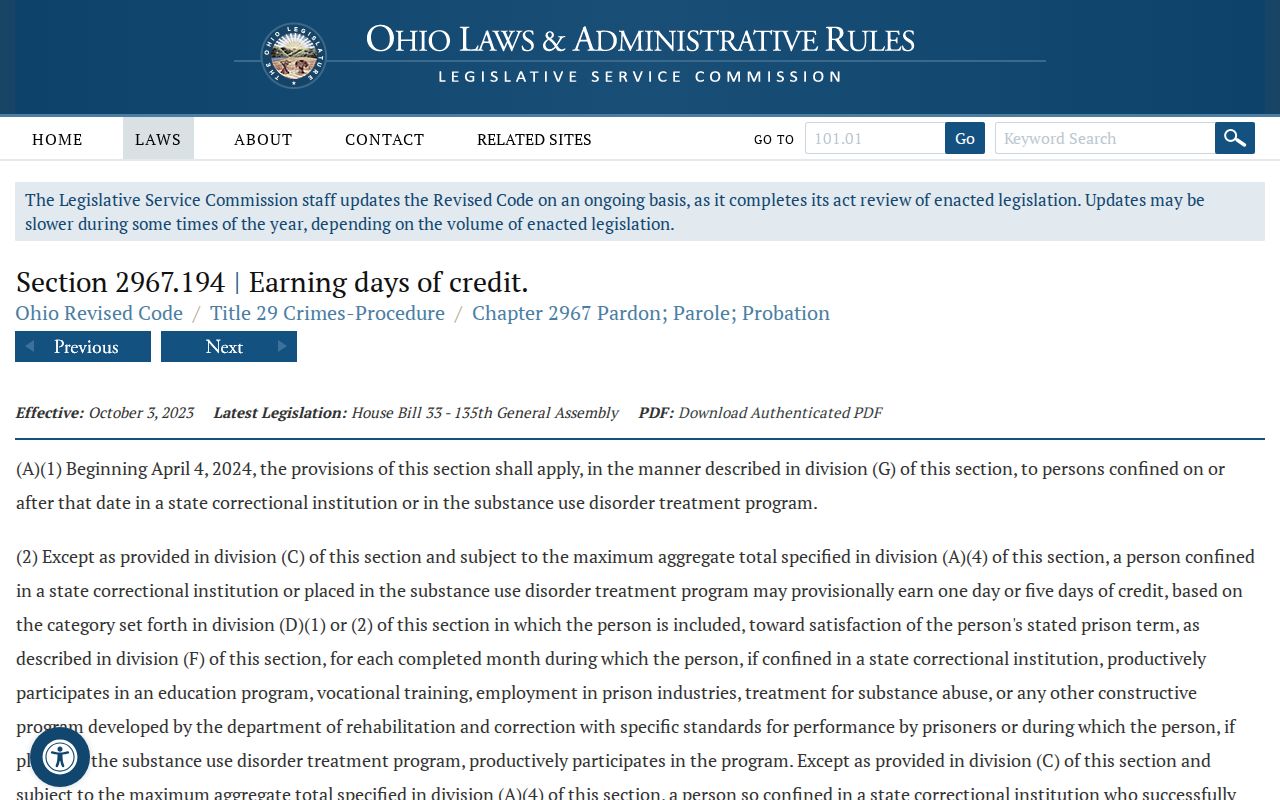
Apply the law only after identifying the sentence. A general credit summary cannot replace the court judgment or ODRC’s current calculation.
Why Ohio's 85% Rule Varies
The most common date error is reversing a maximum credit cap into a promise. A 15% cap on one earned-credit category does not mean every Ohio prisoner serves exactly 85%. Eligibility, documented participation, mandatory time, excluded offenses, sentence era, and final agency approval all matter. Other completion credit may follow different limits, while jail-time credit comes from the court.
Definite, non-life indefinite, life, and old-law sentences also use different frameworks. ORC 2967.271 governs qualifying non-life indefinite release. Parole-eligible life terms reach a chance for Board consideration, not an automatic release. Judicial release can arise from a court order, while Transitional Control is an ODRC placement. Discipline may affect provisional credit.
No Coshocton County jail good-time formula or weekend-release policy was verified. State-prison credit rules must not be imported into a local jail forecast. For a county sentence, use the local judgment, Sheriff schedule, and completed release record.
Note: A changed ODRC date may reflect a lawful recalculation, so compare the current detail with the judgment before alleging an error.
What Changes Coshocton Release Dates
A projected date can move forward, move back, or become a different type of milestone. The source record should identify why. Do not guess from the direction of the change.
| Factor | Possible date effect | Record to check |
|---|---|---|
| Late court paperwork | County schedule may not change until its next daily upload | Signed order and next Sheriff report |
| Additional bond or hold | Person remains held after a tentative date | All case dockets and Sheriff release record |
| Jail-time credit | Qualifying prior confinement reduces applicable time | Sentencing judgment and ODRC detail |
| Earned credit or discipline | Provisional calculation may change | ODRC detail and governing law |
| Consecutive sentence | Terms may be served in sequence | Judgment and sentence structure |
| Parole action | Eligibility may lead to review, not automatic release | Hearing information and release detail |
| Judicial release or Transitional Control | Custody or placement changes under distinct authority | Court order or ODRC record |
Confirm Coshocton Actual Release
After the expected time, check the current county roster as a snapshot. If the name is absent, do not stop. Search Ohio VINE for a custody-change event, read the case order, and request the Sheriff’s booking/release record when the actual processing time or destination matters. The Coshocton VINE inmate check explains person-specific alert registration.
For ODRC, separate Status from the date field. Parole or Release Detail may appear after an institutional action. Supervision Start Date can show that prison release began an APA phase. Supervision End Date or Early Termination marks a later endpoint. A hearing date means scheduled review and not a grant.
Identity must be reconciled before the date. An offender number is the best ODRC key. With a name search, compare birth date, Coshocton commitment data, docket, offense, judge, and sentence terms. One person can also have more than one booking or case. Keep the county booking number distinct from the persistent jacket number and the separate ODRC number. A date taken from the wrong episode can look plausible while proving nothing about the custody being researched.
When the record identifies a receiving agency, follow that path. BOP, ICE, another county, or ODRC may still hold the person. Ending one custody episode is not always the end of custody. Confirm the next custodian before describing return to the community.
Preserve a short evidence chain for any confirmed statement. Note the agency, URL, access date, report print date, offender or case number, and exact label. A later reader can then tell whether the source showed a forecast, a legal order, an alert, or an actual disposition. This matters in Coshocton because the daily schedule is overwritten and the current roster is not a release archive. For an older jail event, go straight to the durable court docket and the focused Sheriff record request rather than trying to infer history from a current PDF.